
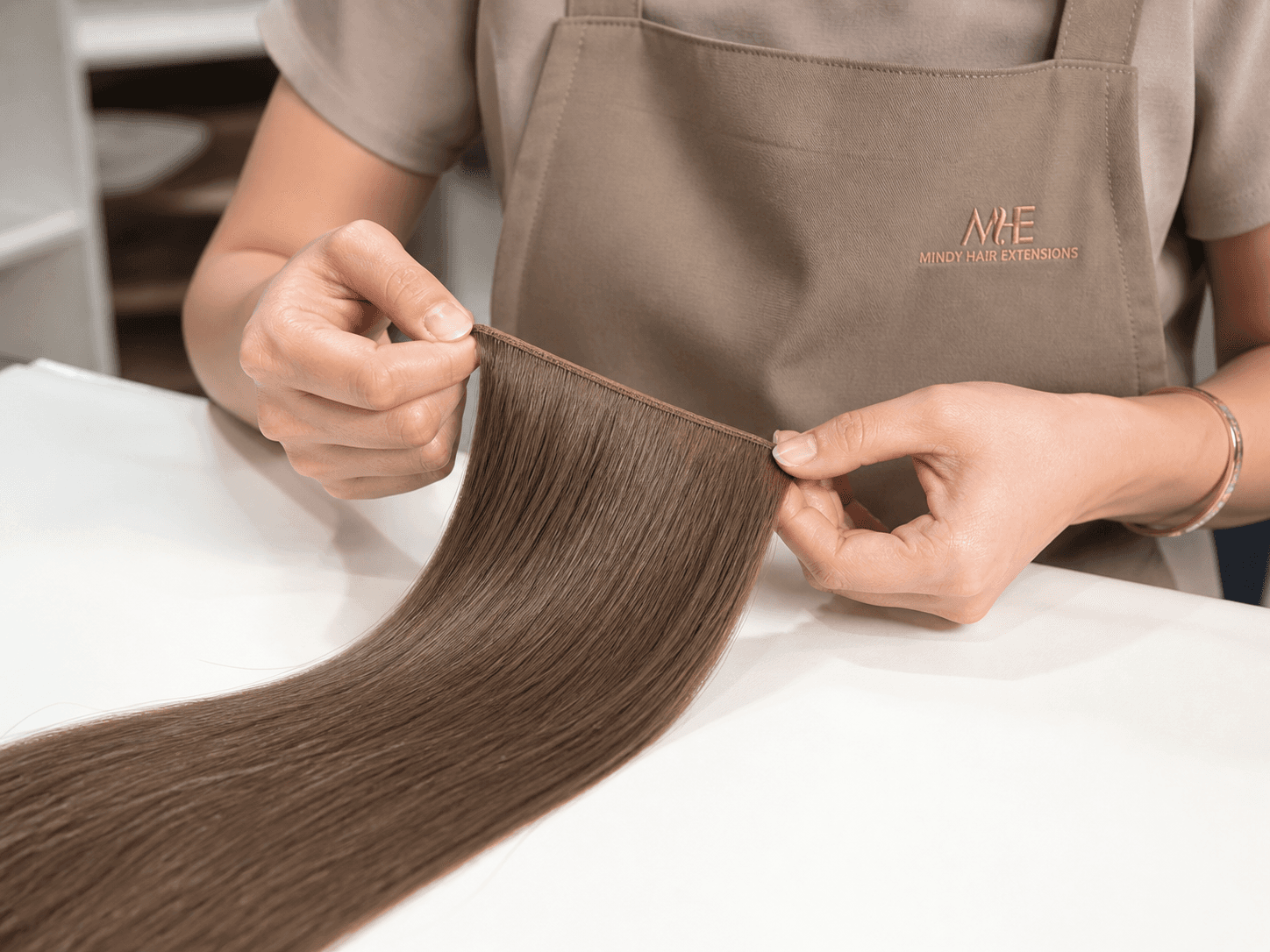
Quick answer
The most reliable hair-extension quality-control process combines an approved control sample, measurable product specifications and a final shipment inspection. For wholesale buyers, the minimum checklist should cover net weight, length, hair direction and tangling behaviour, colour consistency, density, attachment construction, pack count, labels and packaging. A smooth first touch is not enough evidence of long-term product performance.
Why hair extension QC needs a specialist approach
Human hair extensions are difficult to judge from a polished image or one dry comb-through. Some issues only appear when hair is wet, toned, installed, brushed repeatedly or compared against the approved shade and weight. In a B2B order, small inconsistencies can be multiplied across hundreds of packs: a 2–3 g shortfall, an unstable blonde tone, a seam that sheds at the edge, or a packaging label printed with the wrong length.
The most useful control system is preventative. It begins before production, not when cartons are ready to leave. Buyers should separate three moments: sample approval, in-production checks for custom orders, and final random inspection before shipment.
Step 1: make the approved sample your reference point
Approve a physical sample with a dated specification sheet. Photograph the product in neutral light, record net hair weight, measure the length, note the texture and shade, and label the retained sample with an internal SKU. If a brand uses a colour ring, identify the exact ring revision. This avoids comparing a bulk order to memory or a retouched digital image.
The approved sample does not need to prove every possible performance claim. It needs to establish what the buyer has accepted: hair profile, colour, density, construction and packaging. Any permitted variation should be written down before mass production starts.
Step 2: inspect the hair itself
Hair direction and comb-through
For Remy-positioned products, aligned cuticle direction is a quality objective because inconsistent direction can contribute to friction and tangling. In a controlled inspection, support the seam or bond and comb gently from the ends upward. Repeat after lightly wetting a test section. Note shedding, resistance, short-hair concentration and whether results are consistent across randomly selected packs.
This is an observational check, not laboratory proof of origin or processing. Do not describe a batch as “virgin,” “raw,” or “cuticle intact” unless your supplier documentation and your own verification support that claim.
Length, density and weight
Measure length using one consistent method: lay the hair straight without stretching texture, measure from the top attachment to the longest representative ends, and document how curly or wavy texture is treated. Weigh the net hair, not the retail pouch. Inspect density at the lower third of the bundle, where excessive short hair can reduce usable volume.
Define acceptable tolerances in advance. The correct tolerance is a commercial agreement, not a number copied from another supplier. Higher lengths, processed blondes and custom textures need especially clear approval criteria.
Colour and processing finish
Compare against the approved swatch under a daylight-balanced light source and a warm indoor source. Check root shadow, highlight placement, tone and colour bleed on a small wetted section where appropriate. For custom colours, retain a signed colour reference and state whether tonal variation is allowed between packs or batches.
Avoid a destructive process test unless it has been agreed. Bleaching, chemical straightening or recolouring can change the product and should not be treated as a standard final inspection step. A professional strand test may be appropriate when the product is sold as colourable, but the method and risk should be agreed beforehand.
Step 3: inspect the attachment or weft construction
The attachment system often predicts the client experience more directly than a glamour shot of the hair. For Genius Weft or machine weft, check seam height, straightness, stitch security, loose hair at the edge and cut behaviour against the approved sample. For hand-tied weft, check the relevant return/cut instructions. For tape-in, inspect adhesive alignment, tab size, liner integrity and pack pairing. For keratin tips, inspect the bond shape, individual weight and separation.
Use the intended product instruction as part of QC. A well-made product can still create complaints if the pack does not explain installation, maintenance or professional-use limits accurately.
Step 4: inspect packaging and labelling
Packaging is a product-control item, not a last-minute marketing item. Verify the SKU, length, shade, texture, grams, quantity, barcode, country-of-origin wording where required, care insert and outer-carton marks. Check that the hair stays secure and that there is no compression, moisture exposure or colour transfer risk in the selected pack format.
For private-label orders, approve the artwork proof separately from the hair sample. At final inspection, select cartons from different positions in the order and reconcile pack count against the packing list.
A practical final-shipment checklist
Use a documented random sample plan suitable for the order value and risk. For each sampled unit, record:
- Purchase order and SKU reference.
- Lot, production date or carton reference where available.
- Net hair weight and length measurement.
- Shade and texture comparison to approved control sample.
- Comb-through and visual hair-direction observations.
- Weft, tape, tip or clip construction condition.
- Pack labels, inserts, barcodes and packaging condition.
- Carton count, sealing and shipping marks.
- Photos of pass items and every nonconformity.
When an issue is found, report the count, SKU, location and severity. “Poor quality” is not actionable. “Four of 32 sampled 20-inch shade 18/60 packs weighed 44–45 g against a 50 g net specification” is actionable.
What to do when a batch does not match the approval sample
Pause shipment for material discrepancies where possible. Share documented evidence, not only chat messages: side-by-side photos, weights, batch codes and the approved spec. Ask the supplier to identify root cause, segregation method and correction proposal. The right remedy could be rework, replacement, price adjustment or a revised shipment plan, depending on the issue and your contract.
Do not mix unapproved stock into your live inventory just to protect a launch date. It makes later traceability and customer communication much harder. For recurring programmes, log every nonconformity and use it at the next specification review.
FAQ
How can I tell whether hair extensions are good quality?
Look at a combination of hair direction, comb-through, lower-end density, length, net weight, colour consistency, construction and packaging. Assess samples under the same conditions and retain the approved sample for comparison.
Is a wash test enough to check Remy hair?
No. A controlled wet comb-through can be useful, but it does not by itself verify every marketing claim or predict all wear conditions. Use it alongside measurable specification checks and supplier documentation.
Should I inspect every pack?
The answer depends on order value, risk and your supplier history. A documented random sample plan is common for repeat orders; a higher inspection level may be appropriate for a first order, a new blonde formula, a new attachment type or a private-label launch.
What records should I retain?
Keep the approved sample reference, specification sheet, purchase order, factory photos, inspection records, packing list, shipping documents and any corrective-action agreement.
Conclusion: quality becomes manageable when it is specified
Quality control is not a promise printed on a pouch. It is the process of turning a product brief into measurable checks at sample stage and again before shipment. Brands that document product tolerances, retain a control sample and inspect shipments consistently are better positioned to protect their salon partners and reduce avoidable rework.
CTA: request a specification and sample plan
If you are qualifying a new supplier or preparing a private-label launch, Contact Us with your product type, key quality requirements, target shades, packaging and order timing. Mindy Hair Extensions can help structure a sample and shipment-inspection discussion before bulk production.