
Quick answer
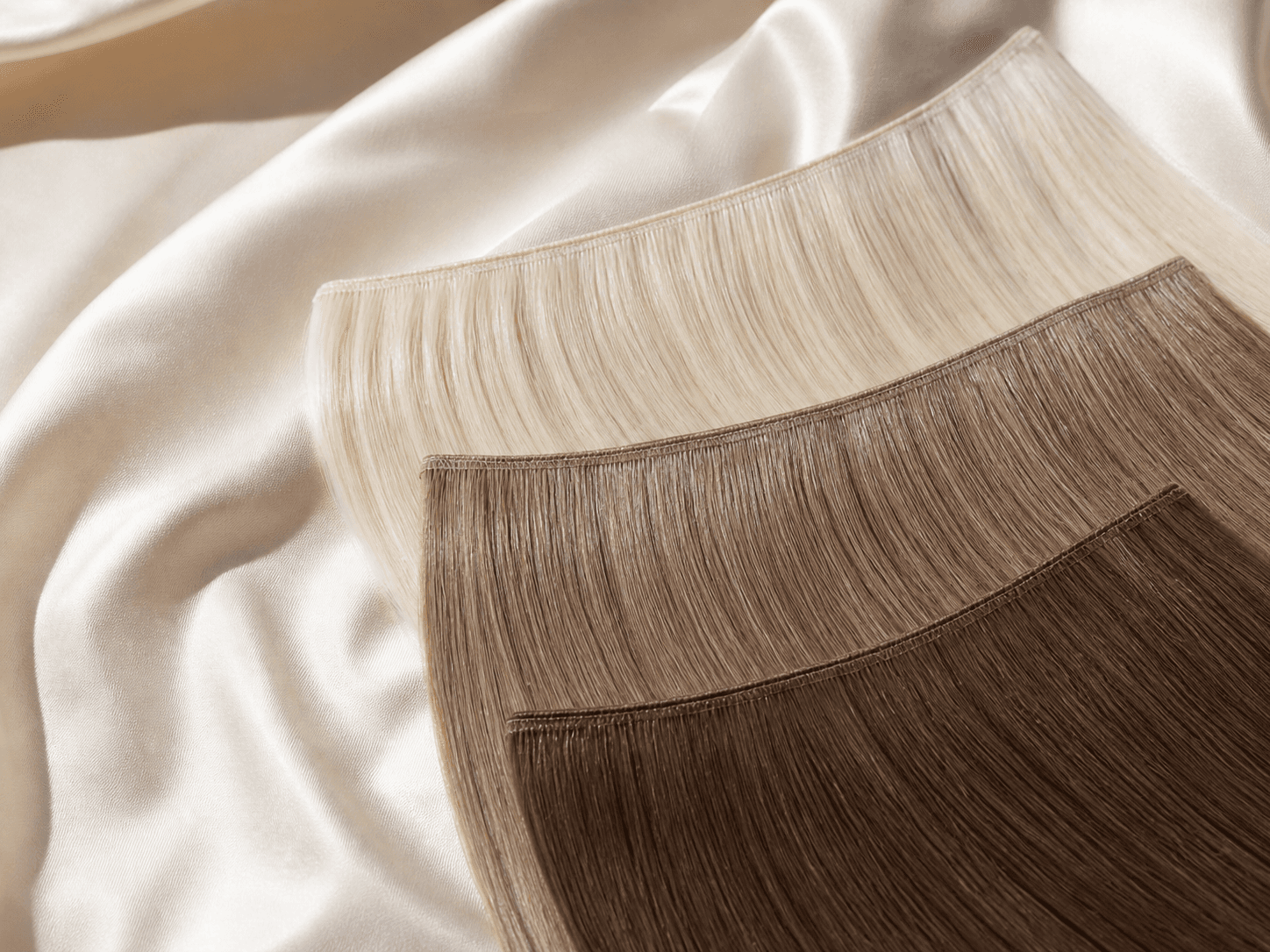
Genius Weft is usually the strongest all-round choice for brands and professional salons that want a thin, cut-to-fit seam with practical production durability. Hand-tied weft remains valuable when the lightest and most flexible seam is the priority. Traditional machine weft is often the most economical and robust option for clients who can accept a thicker attachment. The right choice depends less on a universal “best” label than on the installation system, natural-hair density, price point, target client and the repeatability required for your range.
For a wholesale programme, the buying decision should be made from a physical sample and a written specification—not a product name alone. “Genius,” “invisible,” and “flat” are market terms. Their actual seam thickness, density, width, cut behaviour and hair quality can differ from supplier to supplier.
Why the comparison matters to B2B buyers
The weft seam is not a cosmetic detail. It affects how a stylist works, how the rows sit against the scalp, how much folding is needed at the ends, and whether the finished product can be sold consistently across a salon group or private-label line. A range that photographs beautifully but is difficult to cut, sheds after a move-up, or varies from batch to batch creates returns and training problems.
At Mindy Hair Extensions, we recommend beginning every development conversation with the intended application: invisible bead rows, sew-in work, flat-track installations, volume services, or a mixed salon menu. This makes the product brief more useful than a generic request for “best quality hair.”
What is a Genius Weft?
A Genius Weft is a machine-constructed weft designed to have a very narrow, flat upper seam. Its practical appeal is that the track can normally be cut to the required width without the same return-hair issue associated with many hand-tied wefts. That gives stylists flexibility to tailor each row instead of folding a long weft back on itself.
The term does not define one fixed specification. Before ordering, ask the supplier to confirm:
- Finished seam height and thickness, measured on the supplied sample.
- Grams per pack and the usable width per pack.
- Length, texture, colour and drawing ratio.
- Whether the weft can be cut at any point, and how the cut edge is secured.
- Recommended installation methods and professional-use limitations.
- Whether production samples and bulk production use the same hair specification.
Where Genius Weft performs well
Genius Weft is commonly selected for installations where a low-profile seam and a custom row width are both important. On medium to fine hair, reducing unnecessary folding can help an installer keep the top of the row less bulky. It can also be a sensible catalogue product for brands that need one versatile weft rather than separate hand-tied and traditional machine-weft SKUs.
It is not automatically suitable for every client. Very fragile natural hair, a scalp concern, or an unsuitable installation technique should be assessed by a trained professional. A flatter seam does not remove the need for correct tension, balanced sectioning, maintenance and aftercare.
What is a hand-tied weft?
Hand-tied weft is valued for an exceptionally light and flexible top seam. The construction can sit very close to the scalp and is popular in refined weft-row work, particularly where a stylist wants minimum bulk. The trade-off is operational: many hand-tied wefts need their ends returned rather than cut directly, because cutting can cause the hand-tied construction to unravel.
For a salon, that can mean more time measuring, placing and finishing each row. For a buyer, it means packaging and training should clearly explain the cut/return requirement. Hand-tied wefts can also be less forgiving of repeated handling than a well-made machine construction.
When hand-tied is the better choice
Choose hand-tied when your target stylist prioritises very soft flexibility, has an established hand-tied installation method, and accepts the extra application discipline. It is often a specialist rather than an entry-level salon SKU. A premium price position may be justified only if the hair density, seam finishing and packaging support that promise.
What is a traditional machine weft?
Traditional machine weft uses a stronger, more visible sewn top. It is typically the most familiar construction in wholesale catalogues and can offer good durability and cost efficiency. The seam can be thicker than Genius or hand-tied options, especially where the construction is doubled or folded. That is not inherently a defect: on dense natural hair or in applications where the seam is covered well, a sturdy machine weft can be a very practical choice.
It is often useful for buyers who need a dependable, price-conscious product, bulk volume services, or a resilient base for sew-in applications. The buyer should still inspect whether the seam is straight, secure, comfortable and proportionate to the finished hair weight.